
- The better AI gets at doing our thinking, the more deliberate we must be about doing our own.
- Oversight without independent judgement becomes theatre - approval boxes are not governance.
- Productive friction - forming your view first, challenging reasoning, human gates for consequential calls - improves decision quality.
- Treat AI as a sparring partner and build independent critique into product development.
AI is taking on more of the busy work in knowledge-intensive roles. That is worth celebrating. It can remove hours of searching, drafting, summarising, and administrative effort from a working week.
But there is a tension hiding inside that benefit. When AI consistently gives us the first answer, forms the argument, and recommends what to do next, we get fewer opportunities to exercise the critical thinking needed to recognise when it is wrong.
A recent position paper by Margaret Mitchell, Avijit Ghosh, and Samir Passi, AI Agents Push Humans Out of the Loop, argues that current agent design not only makes effective oversight difficult—it can degrade the attention, situational awareness, critical judgement, and domain skill that oversight depends on.
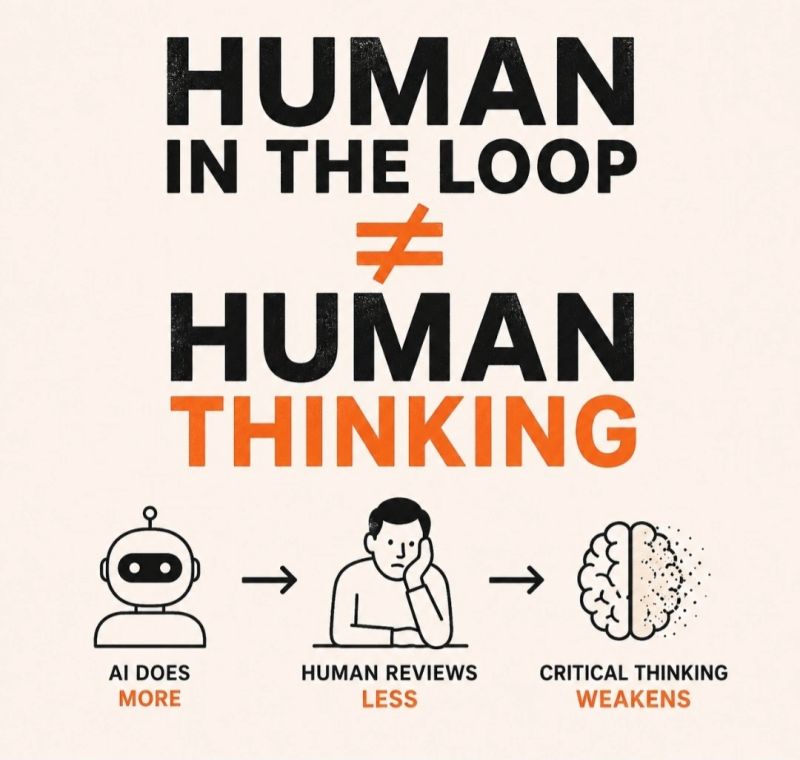
The better AI gets at doing our thinking, the more deliberate we need to be about doing our own.
The presence of a human does not guarantee oversight
Agentic systems make oversight harder than reviewing a single prediction or generated answer. A person may need to follow a multi-step plan, understand tool choices and permissions, recognise cascading failures, and anticipate consequences while still trying to complete their own task.
Repeated approval prompts can create approval fatigue. Voluminous output can exceed a reviewer's capacity. Over time, automation bias and reduced practice can weaken the very skills needed to intervene when a rare, consequential failure occurs.
Putting a human approval box at the end of every workflow is therefore not enough. Approval without attention, context, competence, or an independent perspective can become theatre.
Cognitive scaffolding needs two layers
The paper proposes a two-pronged response. Developers should create design-level affordances that support active oversight during agent operation. Deployers should establish organisational protocols that maintain attention and skill over longer periods. Neither layer is sufficient on its own.
Design AI workflows for active judgement
The research groups several product and runtime interventions under strategic friction, approval design, and behavioural monitoring.
- Pre-commitment: ask people to record their own view before seeing the agent's recommendation, reducing anchoring and creating an audit trail.
- Delay and choice: preserve the option to work unaided or decide when AI assistance should appear, rather than making it permanently “on”.
- Reasoning probes: ask questions at high-stakes moments, such as what evidence would change the decision or which assumption an approval relies on.
- Action gating: require explicit verification before consequential actions and present alternatives instead of a single recommendation to accept or reject.
- Bounded autonomy: define what an agent may do independently and reserve human attention for decisions that genuinely require judgement.
- Batch review and automated pre-checks: present related actions together and use machine checks for properties that do not require human judgement.
Measure whether oversight is actually working
Oversight quality should be treated as a property of the whole human-AI system, not assumed from the presence of a reviewer. The paper suggests watching for signals such as falling review time, declining disagreement with the agent, or fewer requests for evidence as stakes rise.
Known-answer “canary” tasks can test whether people still detect errors and whether agents honestly report their limits. Retrospective audits can compare an agent's summary of its actions with the underlying logs. These methods make oversight observable rather than ceremonial.
Protect human capability at the organisational level
Interface design cannot solve fatigue, skill atrophy, or poor incentives by itself. Organisations also need practices that sustain the people doing the oversight:
- Regularly practise important domain tasks without AI assistance.
- Train people to distinguish fluent output from well-supported output and to recognise predictable failure modes.
- Teach reviewers to notice when fatigue or automation bias is weakening their scrutiny.
- Use breaks and rotations between AI-assisted and unassisted work.
- Assign oversight to people with the necessary expertise and align performance measures so careful intervention is rewarded.
Extend the pattern with independent AI critique
The paper's recommendations on secondary checks and automated pre-checks point to another useful pattern for AI-augmented product development: independent critic agents.
This is my extension of the research into product and technology workflows. Instead of asking the agent that produced an artefact to assess its own output, use a separate critic with different context, goals, and evaluation criteria. A specification agent might optimise for clarity and completeness, while a critic looks specifically for untested assumptions, security risks, ambiguous acceptance criteria, or conflicts with customer evidence.
Independent AI critique does not replace human oversight. It can focus human attention by surfacing disagreement and evidence at the moments where judgement and accountability matter.
Design for the overseer, not only the agent
As agents gain autonomy, the answer is not to put a person in every loop. It is to design the right combination of human judgement, strategic friction, well-scoped autonomy, measurable oversight, and independent checks into the workflow.
AI should not replace critical thinking. It should help us get better at it.